In 2021 I came into possession of a 2001 (fifth generation) VFR800FI. How that came to be is another story entirely. The bike had about 60,000 km on it. As part of freshening it up, I examined the rear suspension linkage.
The shock linkage is accessible after removing the rear wheel and muffler. Thanks be to Soichiro for single-sided swing arms! The linkage parts can be removed and serviced without removing the shock from the frame.
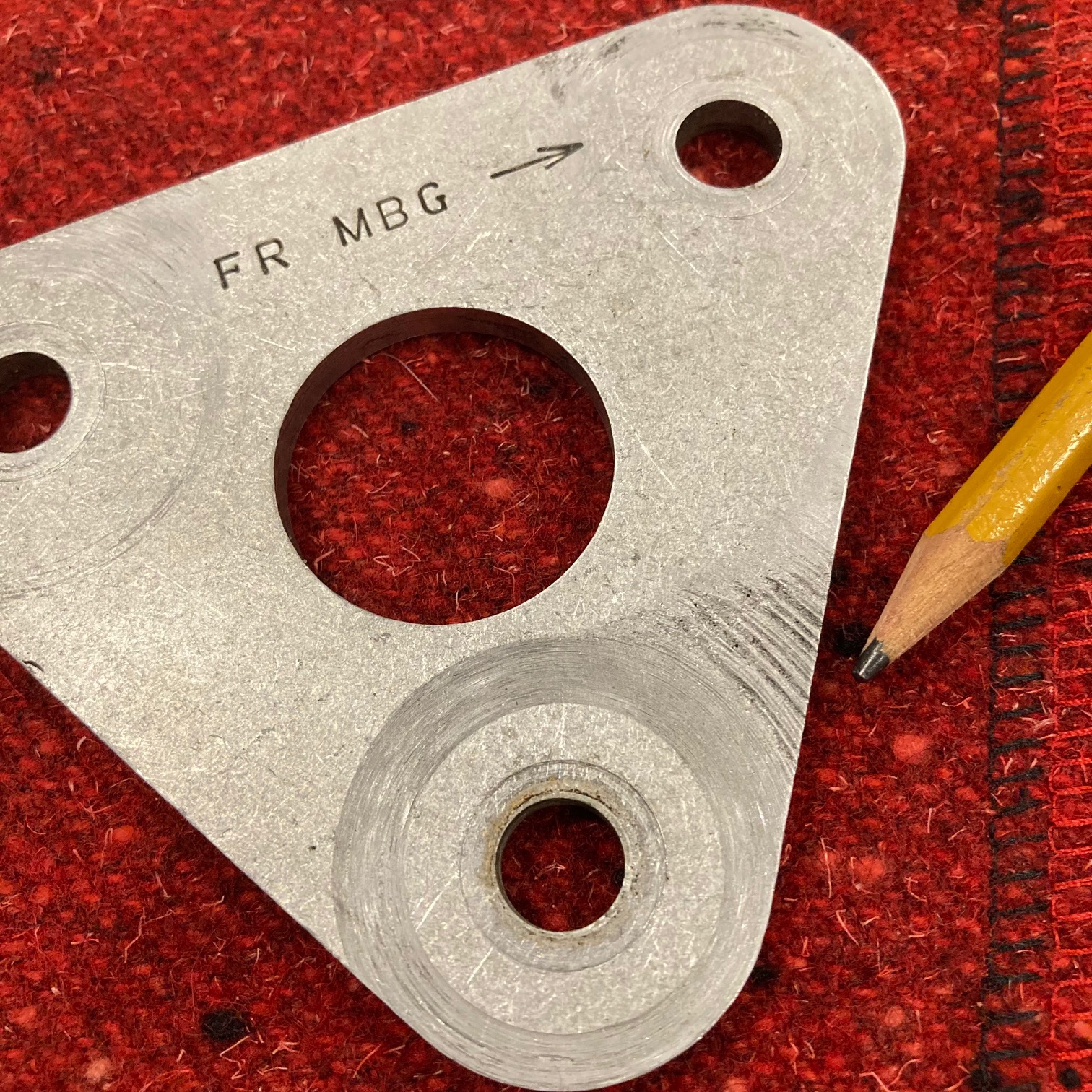
The rear end of the shock link ("dogbone") has a lot of grooves worn into the metal on the left side where it bolts to the triangular metal plate. The front end, which bolts into the frame, showed no such wear.
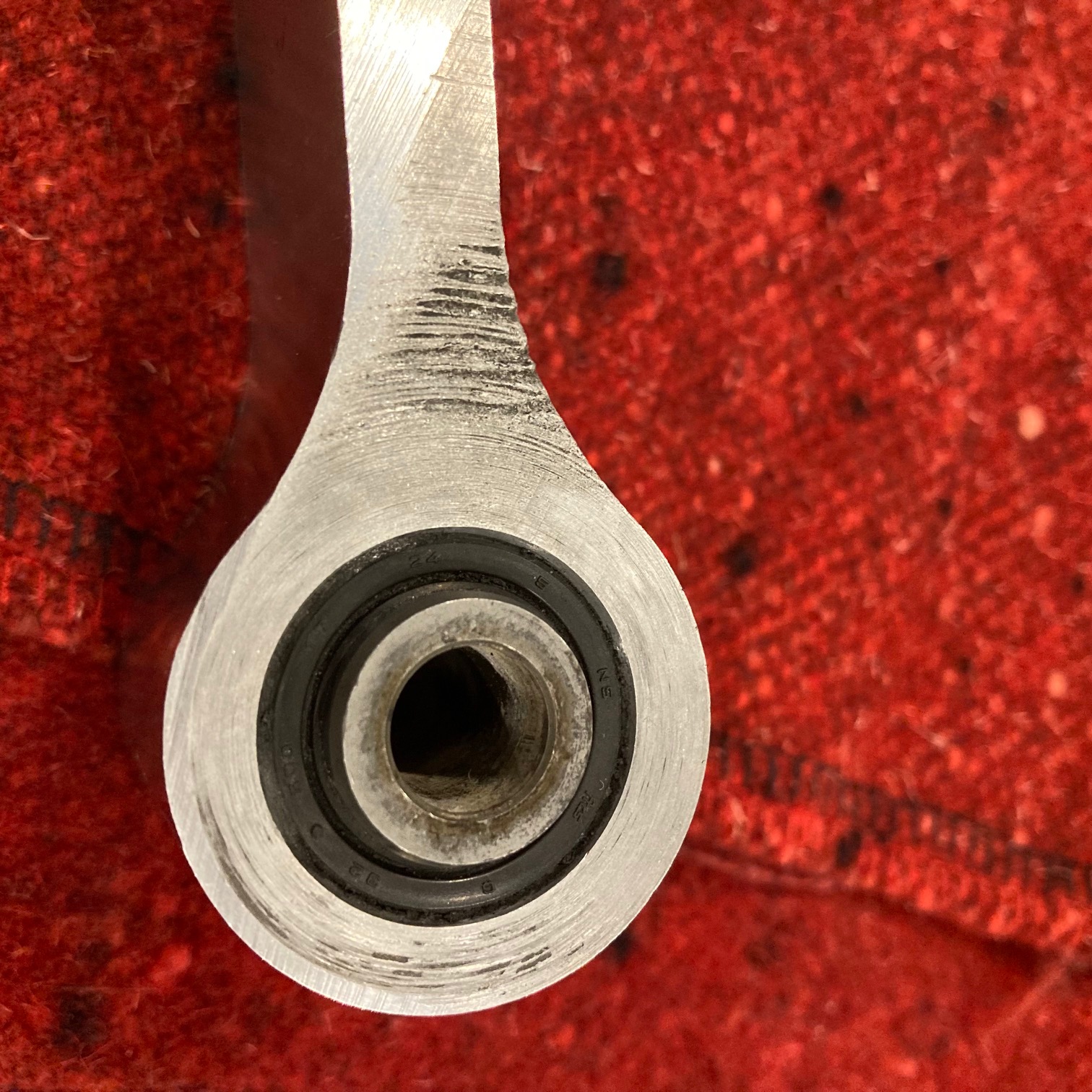
The inside surface of the plate is similarly worn.
This should not happen. The bushings, or collars, are slightly wider than the link, so the plates should stand off the ends of the link a little on each side. In practice, though, it seems that everything shifts to the left, so that all the clearance is on the right, and the parts grind away at each other on the left. How much perceivable effect does this have on suspension compliance? Is this what makes the back end feel a bit harsh on occasion, or is that strictly a matter of compression damping in the shock? I don't know.
I happened to have another VFR800 on hand, a 2000 with about 96,000 km, and it shows the same wear pattern, but worse. Others I asked have seen it too. It seems that this is a common problem. I don't know how to prevent it. Fortunately the left and right plates are interchangeable, so one can swap sides, and then the worn surface will be on the outside on the right, where it doesn't contact anything, rather than on the inside on the left. (Note that the triangular plate is not symmetrical so it cannot merely be flipped over or rotated and used on the same side.) Honda did not release any technical service bulletins, recalls, or updates on the ProLink, so we're on our own to deal with it.
Turning now to the link seals, I found that the seals on the left side were both fine, but the seals on the right side were both worn. The pencil point shows where the inner lips of the seals are torn or partially missing. (I pushed the bushings down a bit to make this more visible.)
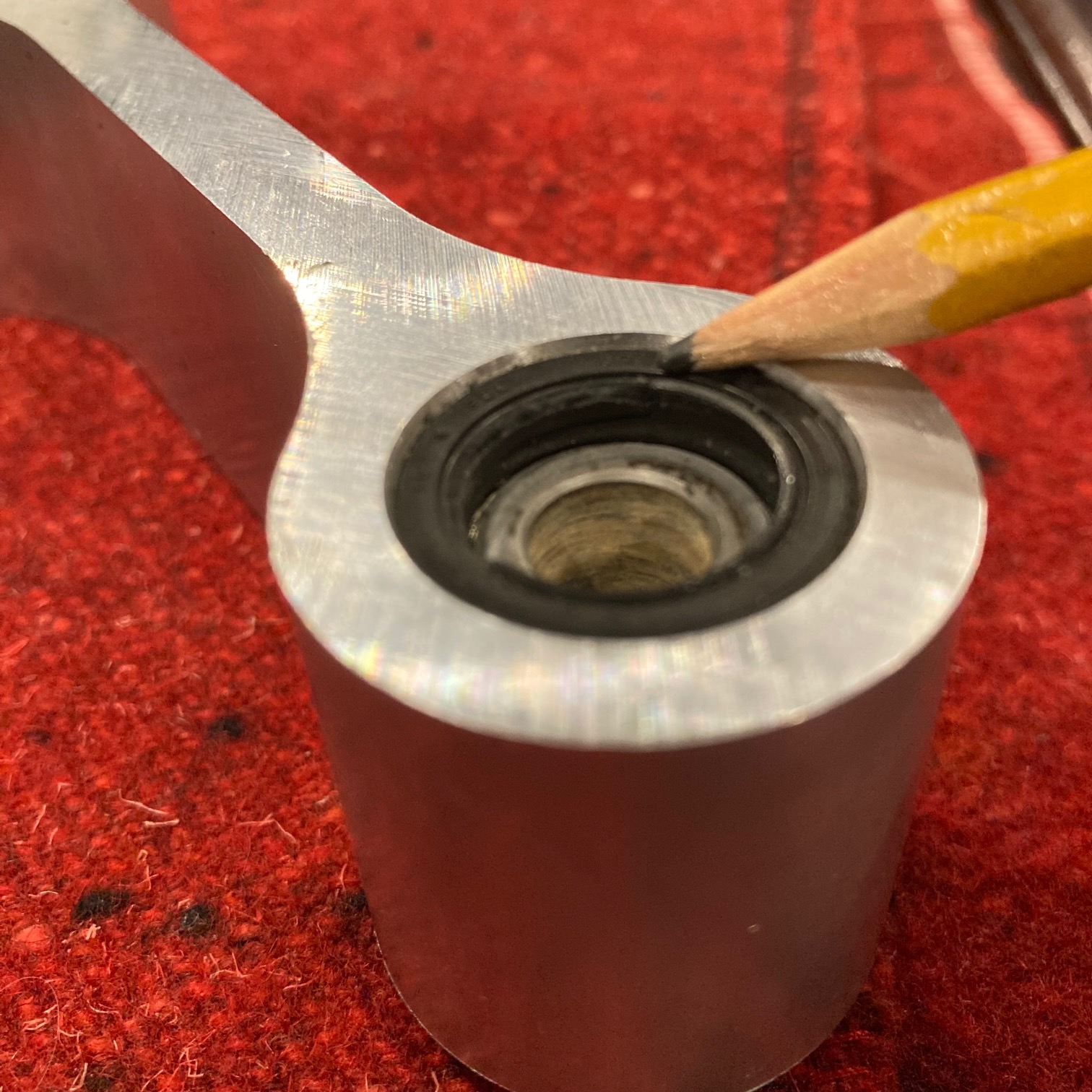
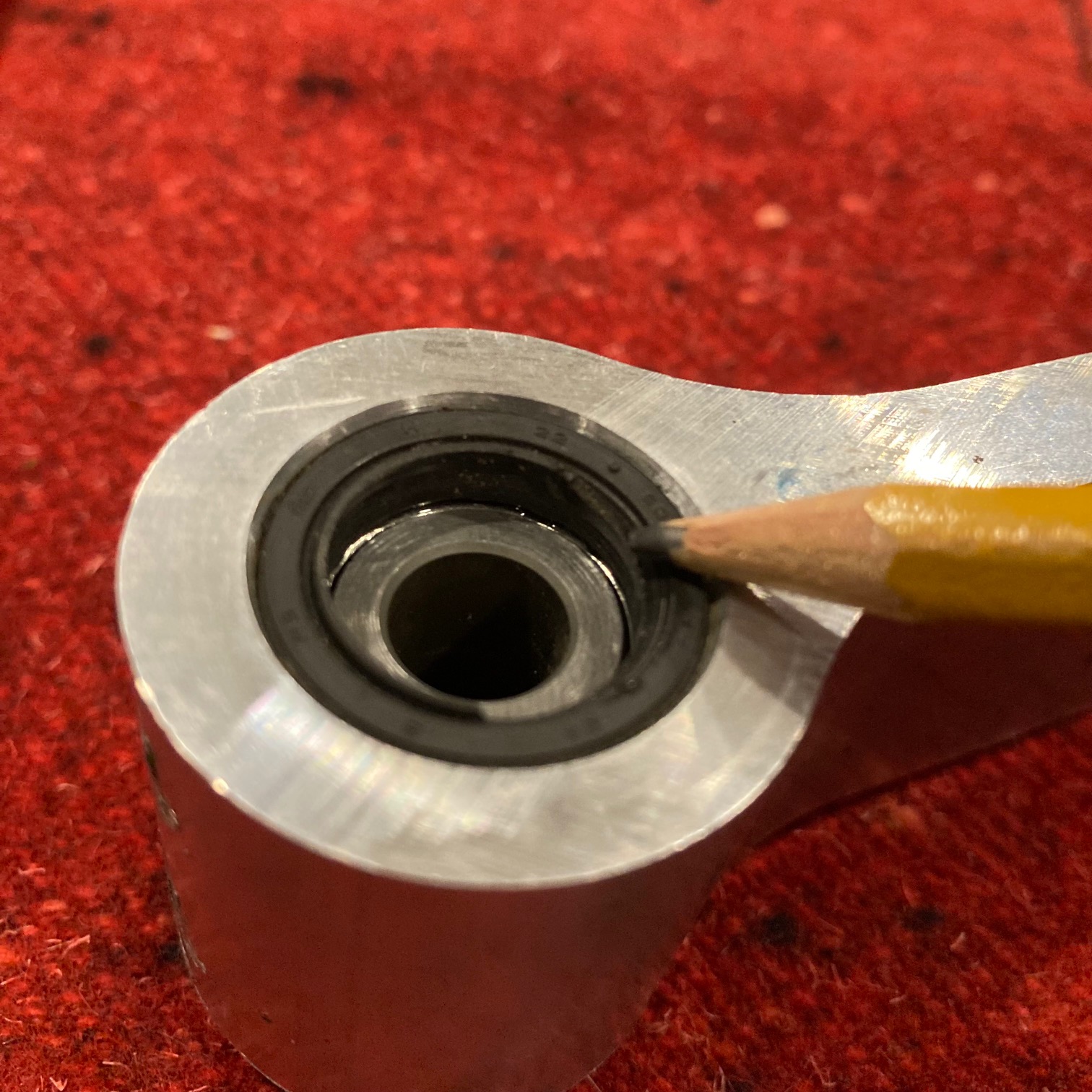
The front and rear bushings in the link both show signs of discolouration and corrosion on the right ends, corresponding with the damaged seals. (The bushings are pushed up a bit to make this more visible.)
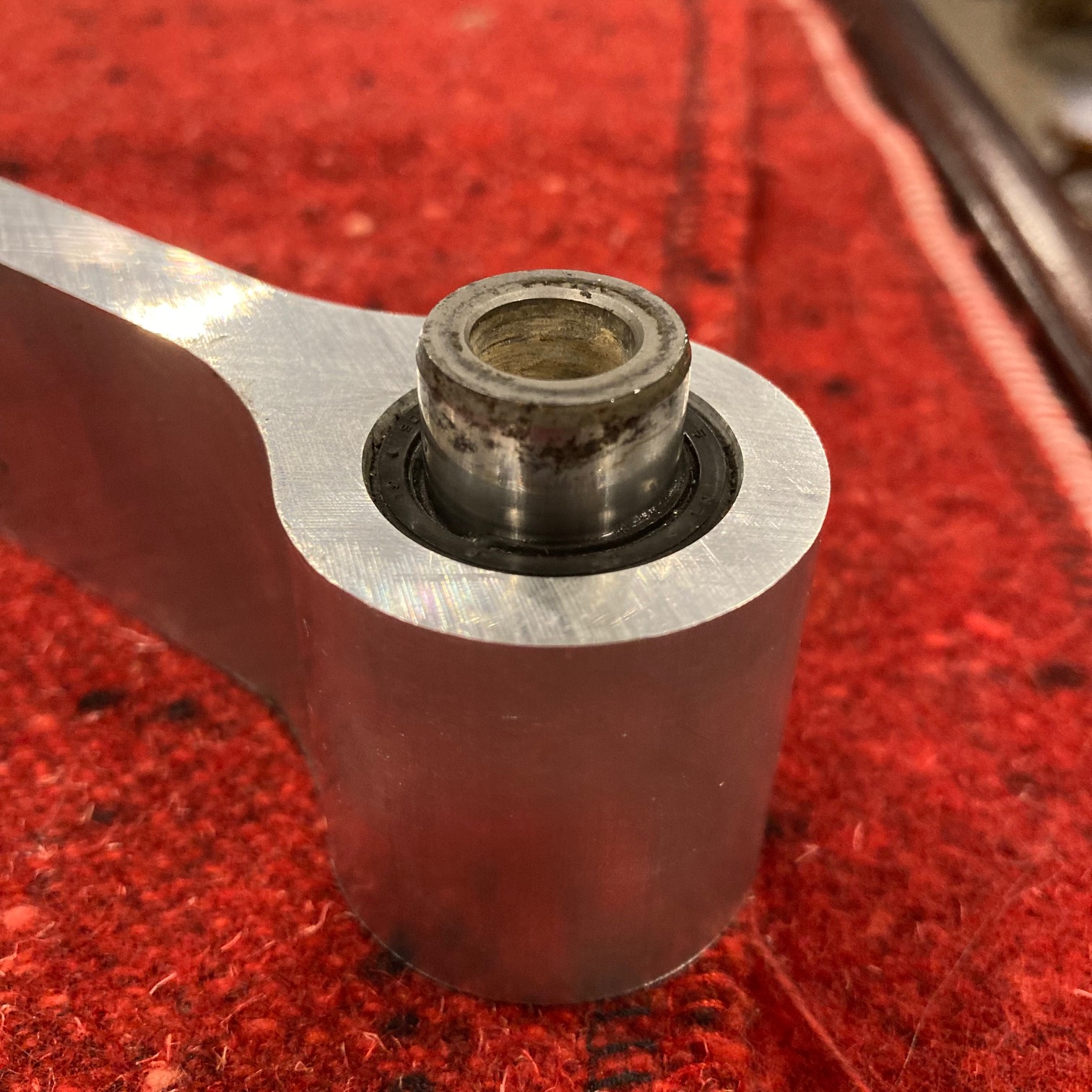
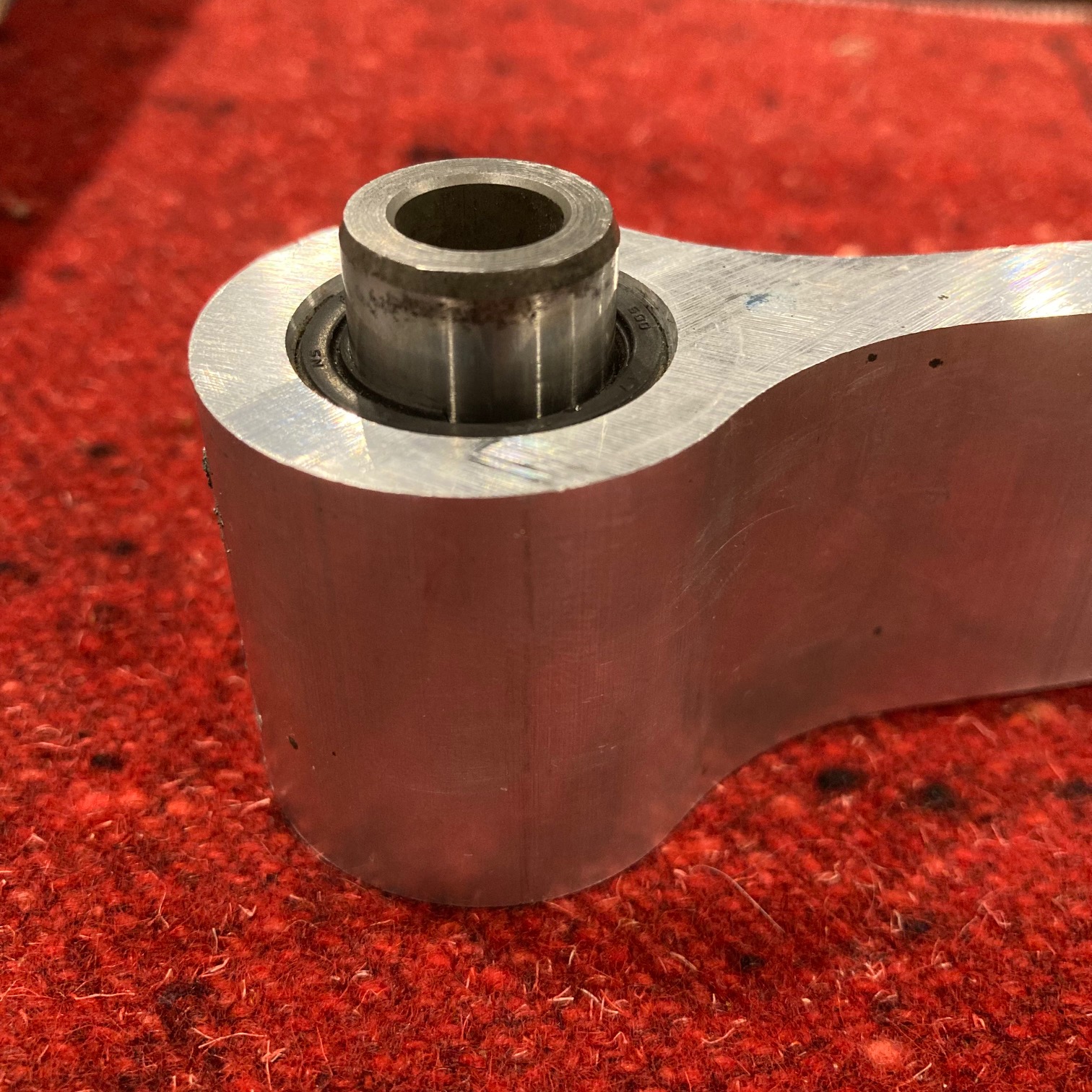
Fortunately, a little bit of time with a Dremel tool and some polishing compound cleaned them up nicely. The weren't pitted or scored so I'm not replacing them. The bearings also looked good inside and rolled smoothly.
The same cannot be said for the 96,000 km 2000 model I examined. The rear seals, bushings and bearings were all in bad shape and definitely need replacing.
New plates, seals, bushings (collars), and bearings are available separately from Honda Canada. The link itself is not sold separately but is available as a kit that includes seals and bearings, but not the bushings or plates. I assume that the kit comes assembled; if so, it's probably a good deal seeing as you wouldn't have to pay for labour to remove old bearings and install new ones.
Having experienced the benefits of a rebuilt and revalved shock on my 1993 VFR750, I anticipated doing the same for the VFR800. But it turns out that I came into possession of a CBR929 shock already adapted for the VFR. The VFR discussion groups (VFRworld, VFRdiscussion) have lots of conversations about this.
The CBR shock offers an integrated remote reservoir and adjustable compression damping, which, for the VFR, are upgrades. (It's amusing that the VFR people are eager to grab those great CBR929 shocks as an upgrade, while the CBR people are eager to ditch those junky stock 929 shocks for an aftermarket upgrade!) This was such a popular move that one suspension guru had quite a business going doing the conversions before switching to producing dedicated VFR shocks.
(By the way, neither the stock VFR800 shock nor the CBR929 shock offer the convenient preload adjustment mechanism that the VFR750 had. Both rely on the crude stepped collar you have to yank around with a clumsy wrench.)
Some special adaptation is necessary because the CBR shock is well over an inch shorter than the VFR shock. Some DIYers accomplish this by welding a cylindrical collar to the top of the stock clevis, and using a longer bolt. Others mill a whole new clevis. The shock I got uses the former method. The pencil in the photo points out the extension collar.
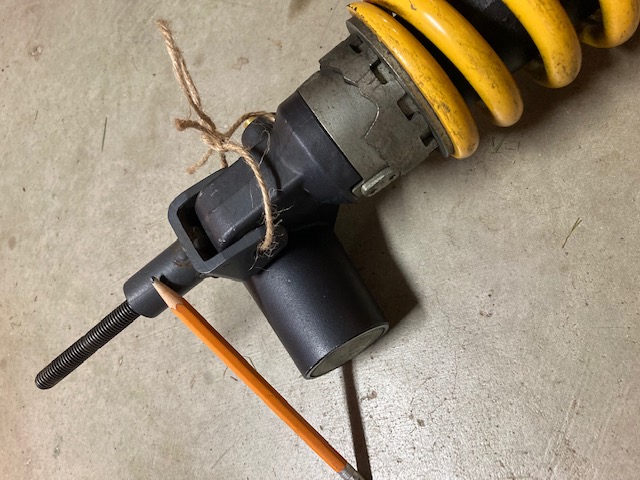
In both cases, one potential disadvantage is that the shock's original pivot remains active, meaning that the pivot point of the overall assembly is no longer located right up at the frame crossmember, but 35mm or so lower. In practice, this does not seem to be a problem; at least, I found no discussion of problems.
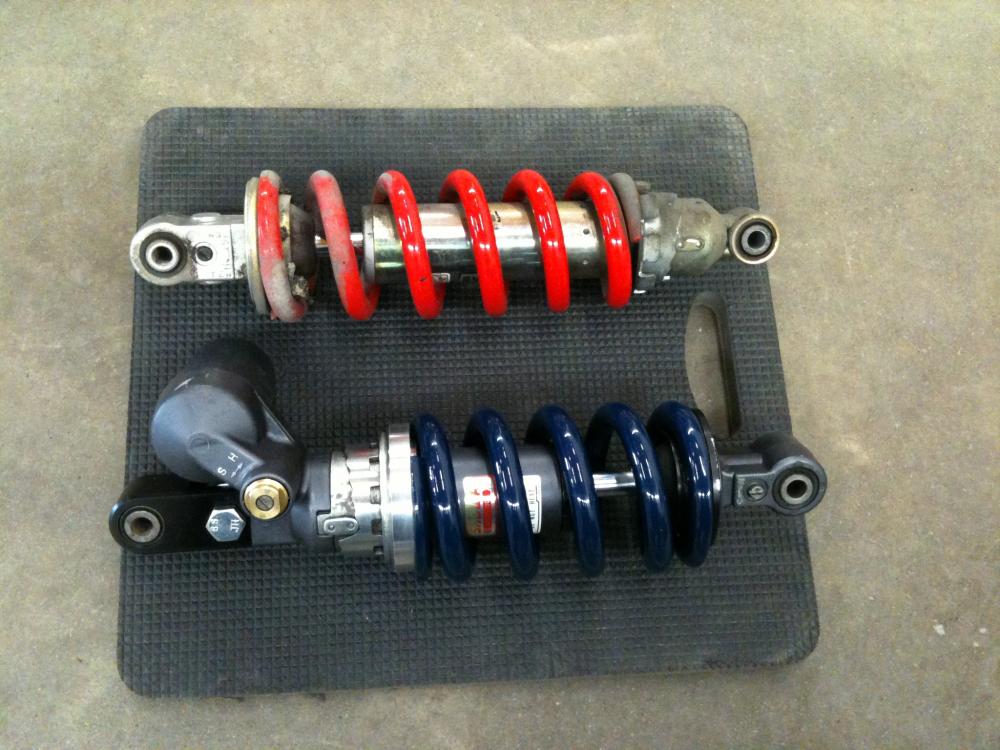
Arguably the better way is to make an adapter that includes a bearing and locks into place on a ledge milled into the top of the shock body. That's how the pro conversion was done. This preserves the original pivot point right up at the frame crossmember.
This photograph shows a stock VFR shock and a CBR929 shock that has been converted in the more dedicated fashion (plus an aftermarket spring).
Since the shock I received was already set up for the simpler way, and I found no reports of problems, I stuck with it, and took it to Cycle Improvements in Waterloo for rebuilding and revalving. The spring rate is 15.3 kg/mm, same as the stock VFR shock. This is too light for the average rider, but works okay for me because I am so slim.